Improving Your Bottom Line With Strategic Full Truckload Shipping
In the modern corporate landscape, supply chain efficiency has evolved from a back-office operational metric into a core determinant of market survival. Global enterprises and mid-market businesses alike are operating under the weight of severe macroeconomic pressures, including highly volatile fuel costs, unpredictable consumer behavior, and a shifting regulatory environment. To shield your operating margins from these compounding threats, it is no longer enough to simply move products from one location to another; you must systematically analyze and optimize every layer of your distribution network.
While logistics managers frequently dedicate the bulk of their strategic attention to overseas manufacturing hubs or high-velocity transportation modes like air cargo freight forwarding, the domestic over-the-road networks operating right on our highways often contain the greatest opportunities for immediate, structural cost reductions. Specifically, mastering the nuances of Full Truckload (FTL) shipping can transform your domestic logistics infrastructure from a massive capital drain into a highly agile, competitive advantage that actively improves corporate profitability.
Defining Full Truckload Shipping within Global Logistics Networks
To fully appreciate the financial and operational leverage that Full Truckload shipping provides, it is valuable to examine how freight moves through broader global distribution frameworks. According to foundational industrial definitions detailed on Wikipedia, a professional freight forwarder functions as an architect of transportation networks, coordinating complex movements across ocean lines, air corridors, and domestic highways to ensure peak efficiency. Within over-the-road logistics, these domestic networks are fundamentally split into two primary operational methodologies: Less-than-Truckload (LTL) and Full Truckload (FTL).
The primary differentiator between these two modes centers on trailer exclusivity rather than physical volume. In a standard LTL model, a shipper purchases a small portion of a trailer's capacity, sharing the remaining space with cargo from entirely unrelated companies. Conversely, booking an FTL shipment grants your business exclusive rights to a dedicated 53-foot trailer. A common operational misconception is that a company must possess enough inventory to physically fill a trailer to its roofline before FTL becomes viable. In reality, whenever a single shipment weighs more than 15,000 pounds, spans more than 10 to 14 standard pallets, or contains highly fragile cargo, dedicating an entire truck to that specific inventory becomes the more strategic asset management decision.
The Hidden Financial Liability of Overusing LTL Shipping
While Less-than-Truckload shipping appears highly economical on individual, low-volume freight invoices, relying on this model as your primary scaling mechanism introduces substantial hidden liabilities to your balance sheet. The financial strain of the LTL framework stems directly from its reliance on a complex hub-and-spoke distribution model. Instead of a driver traveling directly from your warehouse to your customer, an LTL shipment is subject to continuous handling. Cargo is loaded at your facility, transported to a local terminal, cross-docked, consolidated with other freight, sent to a regional hub, and unloaded once more before it ever reaches its final destination.
Every distinct point of contact by a forklift or warehouse team exponentially escalates the risk of freight damage, pallet breakdown, and inventory loss. The administrative costs required to manage product insurance claims, expedite replacement shipments, and appease dissatisfied clients rapidly consume whatever upfront capital savings were initially projected. Furthermore, LTL carriers utilize highly restrictive pricing algorithms that penalize shippers for bulky, lightweight, or unusually shaped cargo through strict linear foot rules and shifting freight classifications. When your monthly shipping volumes reach a predictable, recurring baseline, continuing to buy trailer space piecemeal results in a significant financial penalty.
Strategic FTL Shipping as a Direct Driver of Profitability
Transitioning your distribution strategy away from fragmented consolidation and toward a disciplined Full Truckload framework unlocks a series of powerful financial levers that immediately reinforce corporate fiscal health.
Achieving Drastic Reductions in Total Transit Times
Because an FTL carrier secures your freight at the point of origin and drives it directly to the receiving dock without intermediate processing, standard transit times are cut by up to half compared to traditional LTL routing. Reducing your days in transit has a direct, positive effect on cash flow velocity. When inventory moves rapidly across the country rather than sitting stagnant in regional distribution hubs, your working capital turns over much faster. This acceleration allows you to fulfill invoices sooner, maintain leaner safety stocks, and reduce your total warehouse holding costs.
Capturing Economies of Scale and Rate Predictability
Logistics spending is highly sensitive to volume efficiencies. When you purchase the complete capacity of a dedicated trailer, your per-unit or per-pallet transportation cost drops significantly below the rates offered in shared networks. Additionally, while LTL pricing is subject to volatile accessorial charges, dynamic fuel surcharges, and localized terminal fees, FTL contracts provide flat-rate stability. Negotiating a fixed cost per mile or a stable lane rate empowers your corporate finance team to generate highly precise quarterly budget forecasts, protecting your organization from unexpected operational expenses.
Mitigating Freight Damage and Eradicating Administrative Waste
A critical, yet frequently overlooked component of corporate profitability is the elimination of administrative waste associated with supply chain disruptions. When an incoming shipment arrives at a client's facility damaged, shorted, or compromised, the financial impact extends far beyond the physical value of the destroyed goods. The modern corporate environment must absorb a chain reaction of operational inefficiencies: customer service teams must dedicate hours to conflict resolution, warehouse personnel must pause standard operations to process reverse logistics, and manufacturing plants must re-allocate raw materials to produce replacement inventory out of schedule.
A strategic FTL model bypasses this entire cycle of disruption. Once your logistics team loads a dedicated trailer at your shipping dock, the vehicle's doors are closed and secured with a tamper-evident security seal. This seal remains completely intact until the truck crosses the threshold of your customer's receiving dock. Eliminating the constant unloading and reloading native to hub-and-spoke systems minimizes product degradation. By ensuring your shipments arrive in pristine condition, you preserve your brand reputation, eliminate costly chargebacks, and allow your staff to focus on growth-oriented initiatives rather than endless insurance claim paperwork.
Integrating Multi-Modal Systems with Domestic FTL Frameworks
An exceptionally resilient supply chain does not view over-the-road trucking as an isolated operation. Instead, maximum financial optimization occurs when an enterprise seamlessly aligns its domestic ground strategies with its broader international transportation channels. High-level corporate case studies regularly published by Forbes reinforce that organizations maintaining integrated, multi-modal supply chains consistently demonstrate superior financial resilience during periods of severe macroeconomic volatility. Achieving this level of structural agility requires close collaboration with comprehensive freight forwarding services.
For instance, when a business must import high-value electronics, seasonal consumer goods, or critical industrial components across international borders, utilizing air cargo freight forwarding is often necessary to bypass marine port congestion and meet tight delivery windows. However, the premium capital invested in high-speed air transport is entirely wasted if those goods become trapped in a sluggish, fragmented domestic LTL network upon arrival at the airport gateway. By leveraging advanced freight forwarding services, an organization can coordinate an immediate transition from international air freight de-consolidation directly into dedicated FTL trailers. This strategic integration ensures the velocity established during the cross-border transit phase is maintained all the way to final delivery, protecting your investment and maximizing market responsiveness.
Actionable Execution Strategies for High-Yield FTL Operations
Transitioning to a highly optimized Full Truckload model requires careful operational alignment. Shippers must consciously adapt their internal procedures to fully extract the financial benefits of dedicated capacity.
Establish Freight Consolidation Protocols: Corporate logistics departments must routinely audit historical shipping data to detect recurring regional patterns. If data indicates that multiple branches are dispatching frequent LTL orders to clients located within the same geographic territory, those orders should be strategically pooled into a single, high-volume FTL shipment departing on a predictable, weekly schedule.
Maximize Trailer Cube Utilization: To maximize the financial return on your FTL spend, you must minimize empty space within the vehicle. Collaborate closely with packaging designers and warehouse teams to engineer boxes, crates, and pallets that conform to standard 53-foot trailer dimensions. Optimizing your stacking configurations ensures you move the maximum volume of product per dollar spent on driver fuel.
Implement Drop Trailer Initiatives: Carrier detention fees can rapidly erode the cost advantages of FTL shipping. If an over-the-road driver sits idle at your loading dock for several hours while your team prepares a shipment, you will face steep financial penalties. A drop trailer program allows a carrier to leave an empty trailer at your facility, enabling your warehouse team to load the vehicle safely and efficiently during standard shifts without incurring idle driver costs.
Leverage Advanced Transportation Management Systems (TMS): Trucking capacity is highly fluid, fluctuating wildly based on seasonal demands, regional harvests, and consumer shopping surges. Deploying a modern digital TMS allows your procurement team to closely monitor real-time spot market trends, lock in competitive contract rates ahead of peak seasons, and maintain constant visibility over asset tracking.
Aligning Financial Optimization with Corporate Environmental Mandates
In the contemporary business climate, environmental sustainability metrics have evolved past public relations initiatives and are now deeply intertwined with regulatory compliance and capital allocation. Ongoing transportation research frequently monitored by Google News emphasizes that global enterprises face unprecedented pressure from stakeholders and regulatory bodies to accurately document and aggressively reduce their Scope 3 emissions, which represent indirect carbon output across the corporate value chain.
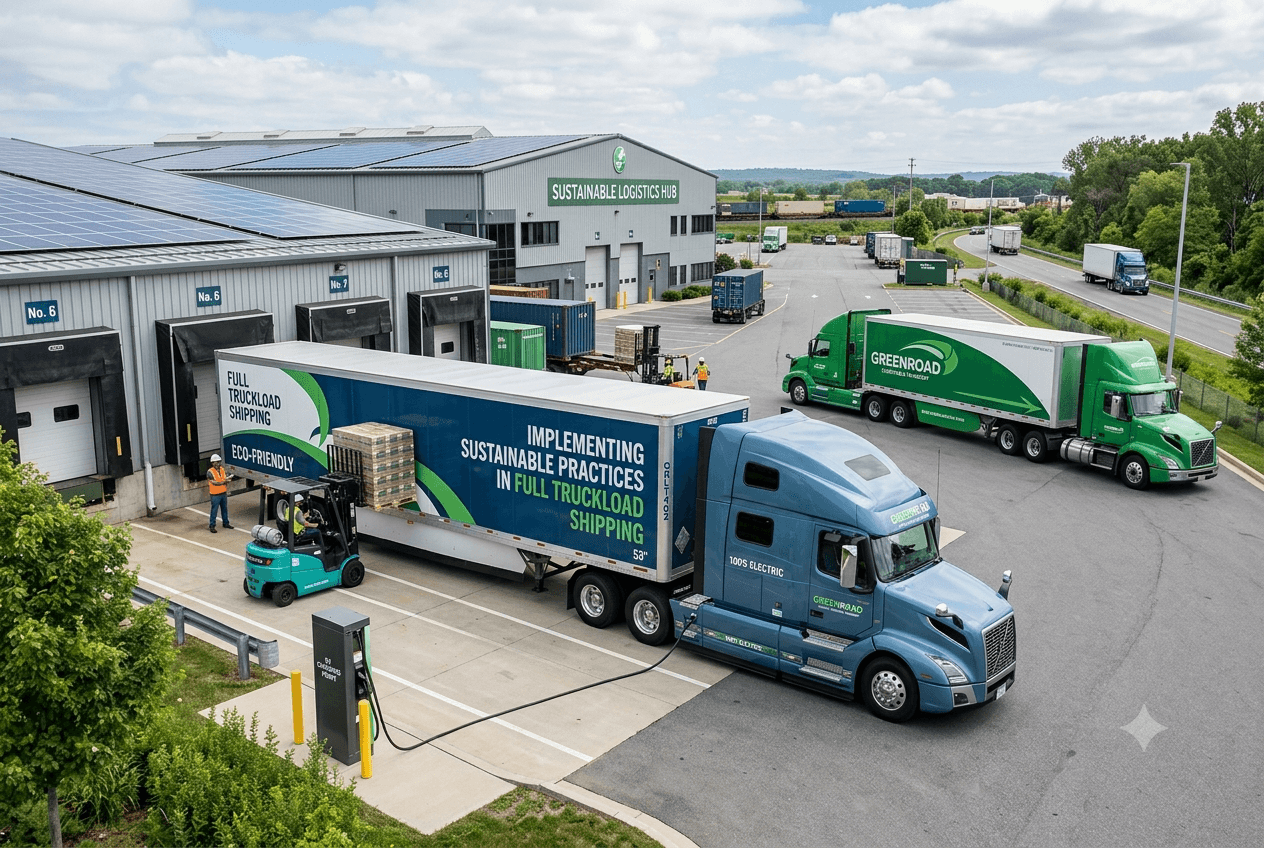
Strategic commitment to Full Truckload shipping provides an elegant mechanism to achieve these environmental mandates while simultaneously reducing overhead costs. Because an FTL truck operates on a direct, uninterrupted route from origin to destination, it eliminates the thousands of empty miles, continuous idling, and circuitous detours that define the LTL hub-and-spoke system. Moving inventory in concentrated, single-source volumes removes unnecessary trucks from the highway infrastructure, driving down carbon emissions per ton-mile and insulating your enterprise from volatile fuel surcharges.
Conclusion: Securing Sustainable Margins Through Logistics Excellence
Optimizing your corporate bottom line is an ongoing process of identifying and eliminating operational friction. While production efficiencies and marketing strategies frequently dominate the executive conversation, the physical movement of your assets across domestic highway systems demands equal strategic scrutiny. Relying on fragmented, high-handling shipping models introduces unnecessary costs, administrative delays, and inventory risks that silently erode your hard-earned corporate margins.